

The Faith of Simeon and Anna
Reflection on Luke 2:22-38

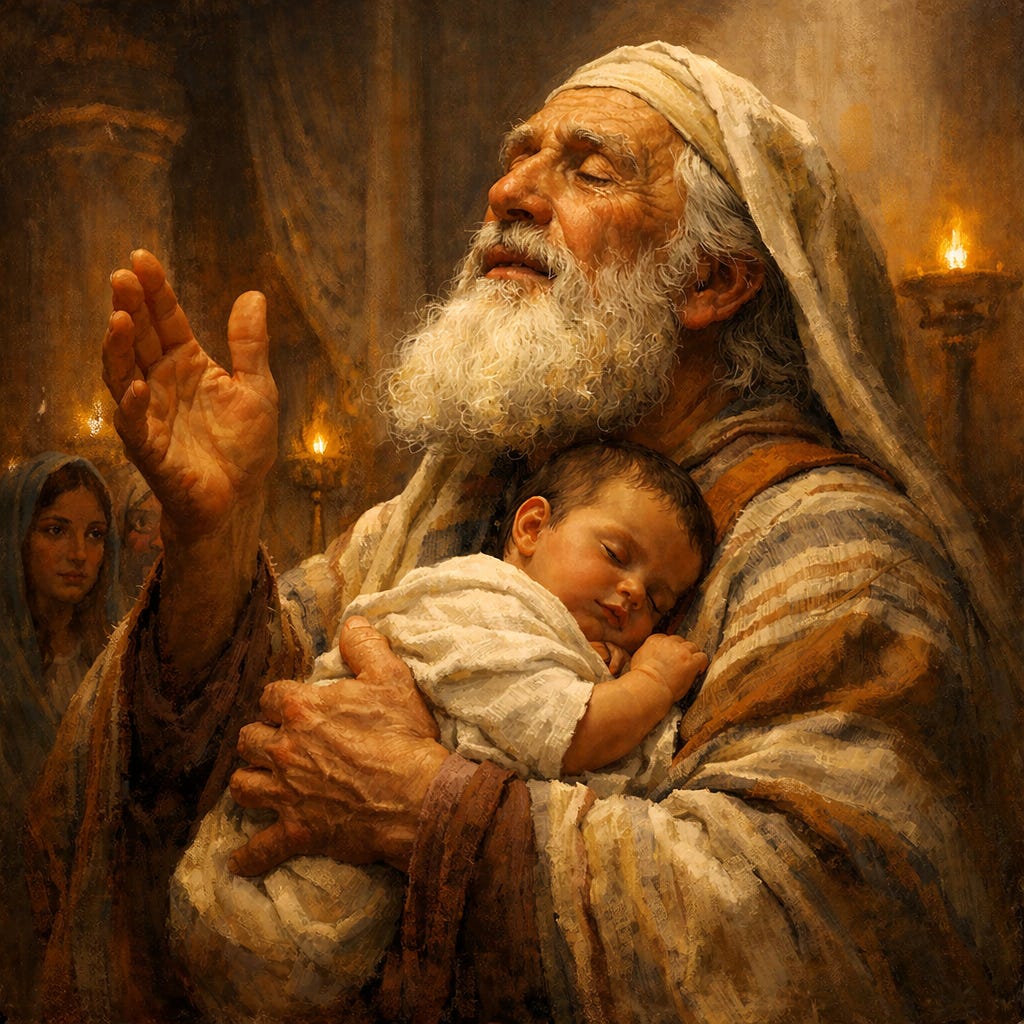
I’ve been lingering in Luke 2:22–38 this Christmas week, reflecting on the luminous accounts of Simeon and Anna and their encounter with the infant Jesus in the temple.
Both are advanced in years. Anna—whose Hebrew name, Hannah, echoes the faithful women of Israel’s past—is said to be eighty-four. Simeon is clearly an older man as well, having been promised by the Holy Spirit that he would not see death before he had seen the Lord’s Christ. Presumably, he had waited a long time for that promise to be fulfilled.
Luke describes Simeon as “righteous and devout,” one who was “waiting for the consolation of Israel,” and who came into the temple that day “in the Spirit.” When Mary and Joseph arrived, Simeon did not hesitate—he took Jesus up into his arms. The long-awaited Savior was now appearing in the flesh.
Anna, meanwhile, is explicitly identified as a prophetess. Yet Simeon is clearly prophetic as well, offering a Spirit-filled blessing over the child who would fulfill God’s ancient promises.
Jesus, of course, was born a Jew and lived under the Law that He came to fulfill. Mary and Joseph faithfully attended to everything the Law required—His circumcision, His presentation in the temple, the offering prescribed for those of modest means. Their obedience is quiet and unremarkable by worldly standards, yet deeply faithful.
Simeon’s blessing confirms what had been foretold:
My eyes have seen your salvation
that you have prepared in the presence of all peoples,
a light for revelation to the Gentiles,
and for glory to your people Israel.
(Luke 2:30–32)
This blessing is both spiritual and physical. Simeon blesses the Christ-child while holding Him—an elderly patriarch cradling the infant Savior. The prophetic ministry is not formulaic, nor does it depend on physical touch as a requirement. And yet, God has ordained the laying on of hands and the ministry of presence as ordinary means through which He is pleased to bless and encourage His people. The blessing flows not from Simeon’s arms, but from his obedience and faith—his readiness to receive and respond to what God had promised.
There is also something deeply familiar here within the story of Israel. Scripture is filled with moments where aging patriarchs bless the next generation—Jacob blessing his sons, and later blessing the sons of Joseph, speaking words that would shape their identity and future. These were sacred moments, often offered near the end of life, when faith had been tested, refined, and clarified by long obedience.
Mary and Joseph, however, were far from home. Forced from Nazareth by the census, and soon to become refugees in Egypt, they were likely deprived of the customary blessing of elder family members over their firstborn son. In Simeon and Anna, God provides something tender and unexpected: faithful elders who stand, in a sense, as surrogate grandparents—receiving the child, blessing Him, and confirming His identity and calling.
What had been spoken by the prophets was now revealed—not to kings or priests, but to faithful servants waiting in hope.
Mary and Joseph must often have felt isolated. They had received confirmation through angels, visions, and divine encounters, but until Jesus’ birth, the news of great joy had not yet been widely proclaimed. Now, roughly forty days later, while Jesus was still an infant, His identity as Messiah was confirmed through the voices and hands of fellow believers—precious saints who had served the Lord faithfully their entire lives.
Luke tells us plainly that Mary and Joseph “marveled at what was said about him.” The blessing of Simeon and the testimony of Anna were not only declarations about who Jesus was; they were gifts of reassurance to two young parents entrusted with an unfathomable calling.
Simeon’s blessing is followed by a more sobering, private word to Mary:
Behold, this child is appointed for the fall and rising of many in Israel, and for a sign that is opposed… so that thoughts from many hearts may be revealed.
(Luke 2:34–35)
Jesus would not merely comfort; He would divide. He would reveal hearts.
John records Jesus’ own words later in His ministry:
For judgment I came into this world, that those who do not see may see, and those who see may become blind.
(John 9:39)
Paul echoes the same truth, writing that Christ crucified is “a stumbling block to Jews and folly to Gentiles” (1 Corinthians 1:23). And Peter would later say that He is “a stone of stumbling, and a rock of offense” to those who do not believe (1 Peter 2:7–8).
Luke then turns our attention to Anna.
She comes from the obscure tribe of Asher, widowed after only seven years of marriage, now having lived decades alone. She had made her home in the temple, “never leaving,” but “worshiping with fasting and prayer night and day.” It is difficult to imagine such sustained devotion. The closest modern parallel might be the lives of monks or nuns, set apart in relative isolation for prayer and worship.
Luke does not record the specifics of her words to Mary and Joseph. Instead, we are told that she “gave thanks to God and spoke of him to all who were waiting for the redemption of Jerusalem.” The text points us to a faithful remnant—not political zealots longing for a military deliverer, but men and women quietly holding fast to God’s promises, waiting for redemption rather than revolt.
Both groups existed in Israel. But these were the ones prepared to see—because they trusted God’s Word and were led by the Spirit to see.
I love this encounter.
The ministry of older saints—those who serve the church primarily through prayer, encouragement, wisdom, and steadfast faithfulness—is often quiet and easily overlooked. And yet, Scripture reminds us of this:
They still bear fruit in old age;
they are ever full of sap and green,
to declare that the Lord is upright;
he is my rock, and there is no unrighteousness in him.
(Psalm 92:14–15)
Simeon and Anna demonstrated a form of devotion that feels rare today. They lived wholly for God—walking in the Spirit, seemingly undistracted by the cares of the world or by the political concerns of their day. By contrast, under our Westernized understanding and practice of faith, many of us seem intent on balancing spiritual devotion with worldly pleasures and pursuits, often with far less time devoted to daily seeking the Lord’s presence, studying His Word, and walking attentively in the Spirit.
I struggle here, because I do not believe the Lord calls all believers to such singular, intense ministries of prayer and intimacy. This was their calling—their gift. And perhaps it is a gift that manifests more fully with age, as faithful believers grow in wisdom and come to see more clearly the majesty and splendor of walking closely with the Father and the Son in the fullness of the Holy Spirit.
Part of what made Simeon’s and Anna’s devotion possible was that they were, in different ways, unencumbered relationally. Anna was long widowed; Simeon appears similarly free from family obligations. The apostle Paul speaks to this reality directly, writing that the unmarried believer is able to be “anxious about the things of the Lord, how to please the Lord,” while the married believer must also be concerned with pleasing a spouse and attending to the responsibilities of this life (1 Corinthians 7:32–34). Paul is careful to say this not as a command, but as a concession—recognizing that different callings carry different demands, and that faithfulness looks different across seasons and stations of life.
For those of us who are married, working full-time, raising children, or caring for aging parents, or others, time and attention are necessarily divided. This is not unfaithfulness; it is vocation.
The call is not to imitate Simeon’s or Anna’s circumstances, but to seek the same posture of attentiveness to God within the limits—and gifts—of the lives we have been given.
Still, I find myself longing for something of what Simeon and Anna had, even while recognizing that it came at a cost. Do I desire to seek the Lord with that kind of singular focus? Yes. Am I able? I’m not sure. But I stand in awe of their example, and I see their lives as something noble—something worthy of our admiration, and perhaps, in whatever measure the Lord allows, our aspiration.
This is the life and ministry of Simeon and Anna. And I am grateful that Luke saw fit to include them in his Gospel—quiet witnesses whose long faithfulness prepared them to recognize their Savior on that special day in the temple, when Jesus finally appeared and came into their arms.
Prayer: Father, thank you for drawing me toward deeper devotion through Luke’s account of Simeon and Anna. Help me to hold fast to you—to trust you, love you, and seek you with greater attentiveness and intention. Grant me the grace to faithfully obey the voice of your Spirit when you call me to share the gifts you have entrusted to me. And work within the limits—and the gifts—of the life you have given me, with your unlimited grace and patience.
Excellent word, Vic, and a challenge to all who want to share in that deep devotion we see in Simeon and Anna! May their tribe increase among us.