

New Wine, New Wineskins
Reflection on Mark 2:22; Isaiah 43:19

This reflection has taken shape over several months of prayer as I’ve sought the Lord’s guidance at a critical juncture in my own life—one that carries implications not only for my personal rhythms, but also for the community life I share with others in my home church. It has reminded me how often God calls us forward before everything feels settled, and how deeply we need to trust Him when obedience precedes clarity.
As one year gives way to another, moments like this tend to sharpen our awareness of change and direction. The new year is often associated with resolutions—setting goals, making plans, and, for believers, anticipating with hope what the Lord might do in the months ahead. Change becomes a recurring theme as we consider what lies ahead. We long to see growth in ourselves: progress in sanctification, forward movement rather than stagnation, freedom from patterns, habits, or even sins that have kept us stuck. In this sense, change can feel intentional—something we pursue through prayer, discipline, planning, and effort.
But not all change is self-initiated. Sometimes it is thrust upon us, whether we are ready or not. And I’m not only thinking of hardship—unexpected illness, loss, or disruption—though those certainly qualify. I’m also thinking of the kind of change that comes wrapped in opportunity: moments when God invites us into something new that stretches us beyond our comfort zone and calls for obedience before understanding.
In those moments, the question becomes deeply personal: Will I resist, or will I obey—even if I can’t yet see where this path leads or understand its purpose this side of heaven?
Scripture is filled with such moments. Abram’s eight-hundred-mile journey toward what would later be called the Promised Land began with a sudden and disorienting call from God: “Go from your country and your kindred and your father’s house to the land that I will show you…” No map. No timeline. No explanation of the cost.
Similarly, Samuel arrived unexpectedly at Jesse’s home and anointed David—the youngest and least likely of his sons—as a future king. There was no immediate crown, no clear path forward, and no warning of the years of waiting, danger, and suffering that obedience would entail.
God does this. At times, He enters our lives without warning and gently—or forcefully—shakes things loose. He calls us forward before we feel ready, inviting us to trust Him not only with outcomes, but with the process itself.
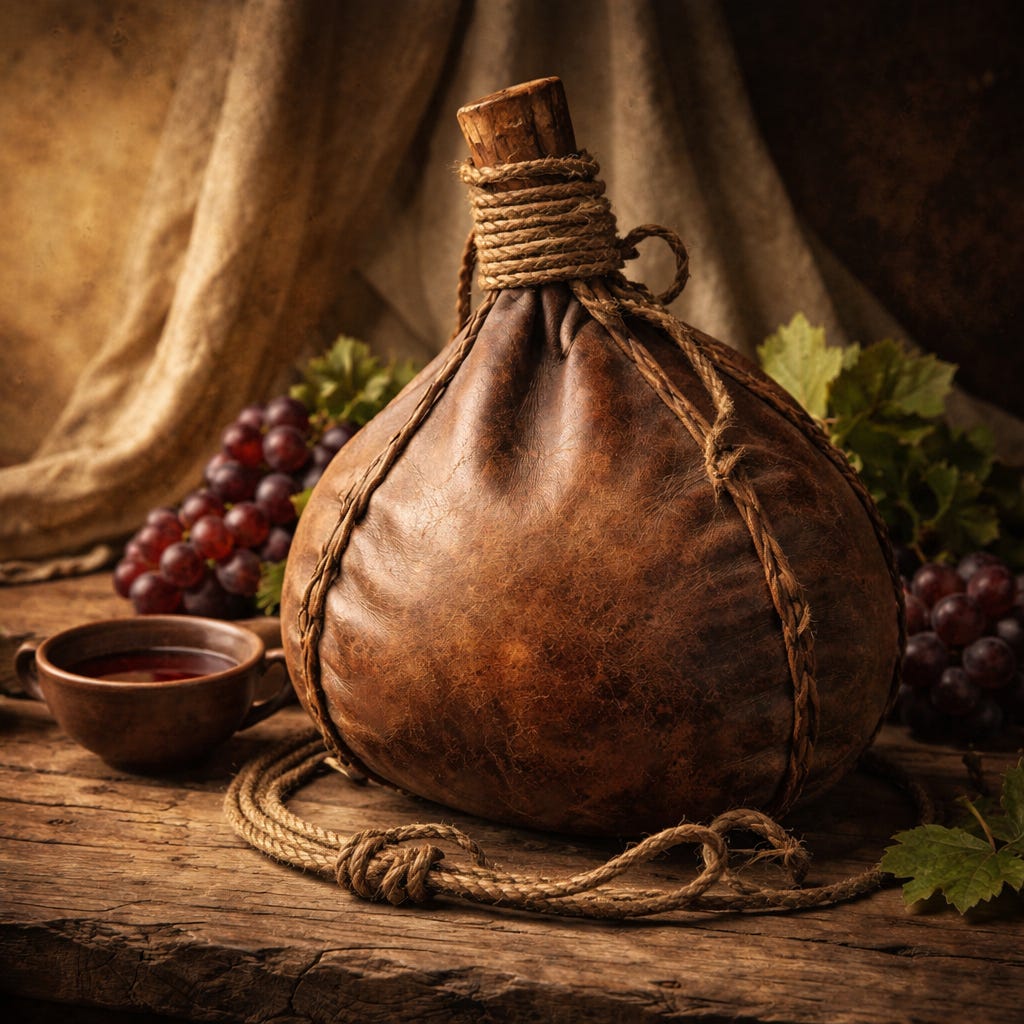
It is in moments like this that Jesus’ words about new wine and new wineskins begin to make sense—not merely as theology, but as a posture of the heart.
Jesus said,
“No one pours new wine into old wineskins. If he does, the skins burst and the wine is lost. New wine must be put into new wineskins.”
(Mark 2:22)
When Jesus spoke these words, He was responding to a question about fasting, but His answer reached far deeper than the practice itself. In all three Synoptic Gospels, this analogy marks a decisive moment in redemptive history: the old covenant was giving way to the new covenant in Christ.
Theologically, the old wineskins represent the Mosaic system and the Levitical priesthood—structures that, by God’s design, offered only partial and repeated atonement. The sacrifices of the old covenant could cover sin temporarily, but they could never cleanse the conscience or remove sin permanently. All of it pointed forward to something better.
Jesus fulfilled the old covenant by becoming both the perfect Lamb and the perfect High Priest—the only qualified sacrifice who could fully satisfy our debt and make us righteous before a holy God once and for all. Because of His finished work, the old wineskins could no longer contain the fullness of the new covenant.
While the new covenant is settled doctrine—firm, final, and unchanging—the principle embedded in Jesus’ analogy of the wineskin remains: God continues to lead His people into new seasons and new opportunities. And when He does, we must be willing to receive what He is doing—willing to stretch, to grow, and to make room for His work in us and among us. The religious leaders of Jesus’ day, hardened by fear and attachment to the familiar, resisted the new wineskin He embodied. Yet even their resistance unfolded within God’s sovereign plan, as the rejection of Christ led to the cross—the very means by which redemption would be accomplished.
This principle is helpfully illuminated by William Barclay in his commentary on this passage:
“There is in religious people a kind of passion for the old. Nothing moves more slowly than a church. The trouble with the Pharisees was that the whole religious outlook of Jesus was so startlingly new they simply could not adjust to it.
The mind soon loses the quality of elasticity and will not accept new ideas. Jesus used two illustrations. ‘You cannot put a new patch on an old garment,’ he said, ‘The strong new cloth will only rip the rent in the old cloth wider.’
Bottles in Palestine were made of skin. When new wine was put into them it fermented and gave off gas. If the bottle was new, there was a certain elasticity in the skin and it gave with the pressure; but if it was old, the skin was dry and hard and it would burst.
‘Don’t,’ says Jesus, ‘let your mind become like an old wineskin. People say of wine, “The old is better.” It may be at the moment, but they forget that it is a mistake to despise the new wine, for the day will come when it has matured and it will be best of all.’”
— William Barclay, The Daily Study Bible, Luke 5:36–39
Barclay’s words are a sobering reminder. The Spirit brings life, and living things expand. Where God is at work, rigidity is not a sign of faithfulness, but a often of fear.
The wineskin Jesus describes is not primarily about physical structures alone; it is about spiritual capacity. At its heart, the image calls us to examine whether our hearts remain supple and open to the Spirit’s work—ready to receive and faithfully steward what God desires to do in and through us as He provides the increase.
As we look ahead to 2026, the invitation before us is simple, though not always easy: to seek the Lord’s direction with open hearts and willing spirits, wherever He may lead. We are not promised clarity at every step, nor are we given advance notice of the cost or the outcome. But we are promised His presence. He is faithful to guide His people, to make our paths straight, and to accomplish His good purposes in and through us.
Through the prophet Isaiah, the Lord declares:
“Behold, I am doing a new thing;
now it springs forth, do you not perceive it?
I will make a way in the wilderness
and rivers in the desert.”
(Isaiah 43:19, ESV)
May we discern and be open to whatever that “new thing” is. May we not allow comfort, fear, uncertainty, or human preference to keep us from moving forward in obedience and faith. May our hearts remain soft and our spirits unified—ready to stretch where He leads, willing to release what we must, and eager to love one another, and others, more deeply in Christ.
And may we continue to ask, with humility and trust:
Lord, what kind of vessel are You shaping us to be? And, may we have the faith to respond, “Here I am, Lord; use me.”
What a good and timely word, Vic. Thank you for your faithfulness to go before the Lord to reflect on this, and then to share your reflections with us. I'm grateful for you and the way the Lord continues to use you to encourage me and the church as a whole!