

Good Friday: The Passion of Christ
Reflection on 2 Corinthians 5:21

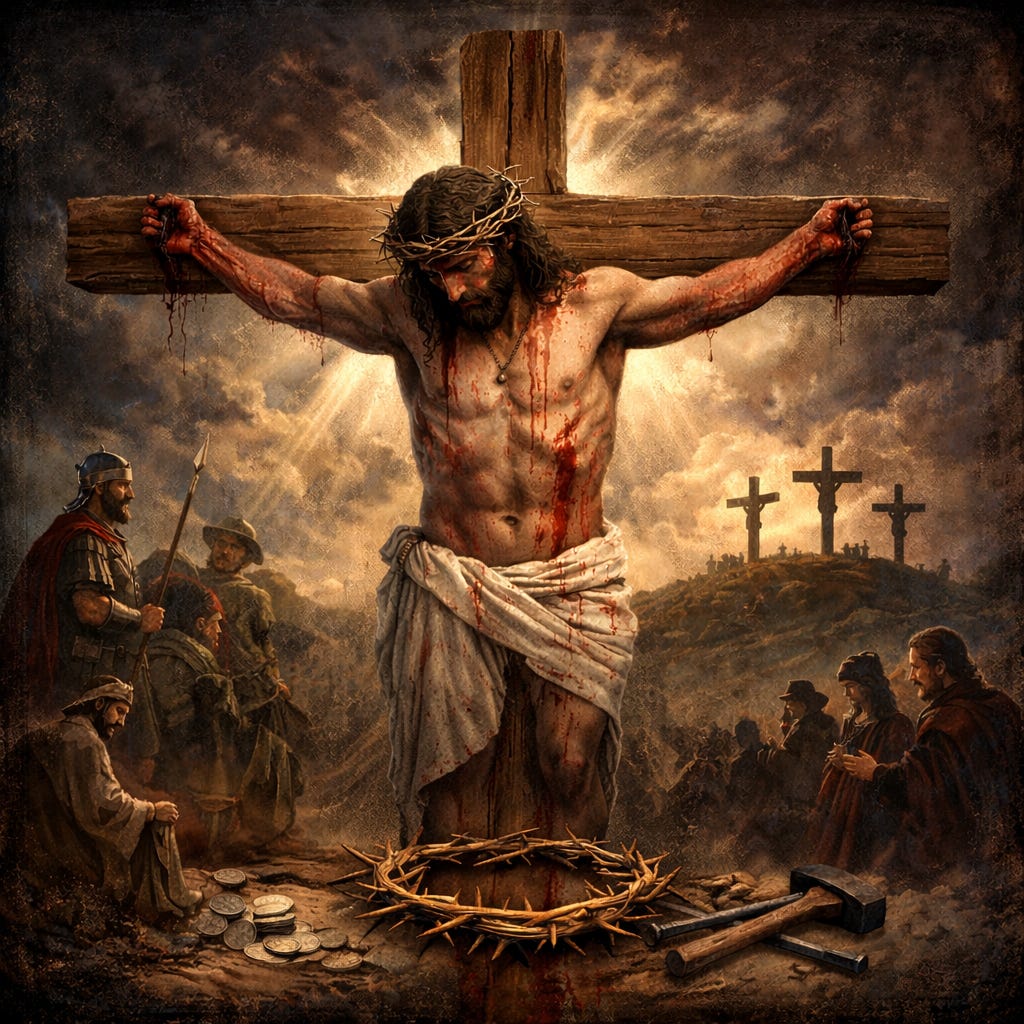
I found myself reflecting this morning on the phrase Good Friday.
At first glance, the word good can feel out of place when considering the events it describes. But historically, dating back to the late 13th or early 14th century, the word good carried a different meaning. It meant holy, pious, or sacred, rather than pleasant or happy.
That distinction matters.
Because there was nothing pleasant about what unfolded on that day.
Likewise, the phrase the Passion of Christ can be misunderstood. Passion here refers not to emotion, but to suffering—the full weight of what Jesus endured:
His betrayal.
The humiliation and mockery.
A sham of a trial, propped up by false witnesses.
The slandering of the only sinless man who has ever lived—the holy Son of God—condemned in a religious tribunal devoid of truth or justice.
The cross—and from a human perspective, an untimely and unjust death.
And yet, He endured it willingly.
As Hebrews reminds us, it was “for the joy that was set before him.”
This was not an unexpected tragedy. It was not history spinning out of control or the triumph of conspiratorial forces determined to preserve social and religious order. And it was not the Father acting in cold anger, nor the Son submitting under compulsion. The cross was a mutual act of love and sacrifice—Father and Son united in purpose.
Jesus obeyed in full submission and devotion to the Father’s will. This was the divine plan—the solution to the human condition—all along.
For our sake he made him to be sin who knew no sin, so that in him we might become the righteousness of God. (2 Corinthians 5:21, ESV)
Paul writes elsewhere with equal clarity:
For all have sinned and fall short of the glory of God. (Romans 3:23, ESV)
That is the human condition. Every one of us stands guilty.
But there is more.
…and are justified by his grace as a gift, through the redemption that is in Christ Jesus, whom God put forward as a propitiation by his blood, to be received by faith.
(Romans 3:24–25, ESV)
This is the heart of the Gospel—the Good News.
And the very essence of Good Friday—Holy Friday.
Theologically, Christ’s death is often described as penal substitutionary atonement. In simple terms, He satisfied God’s justice. If all have sinned, then all deserve the penalty of sin, which is death. On the cross, Jesus bore that penalty in our place.
His death was not symbolic.
It was substitutionary.
He paid a debt He did not owe,
I owed a debt I could not pay;
I needed someone to wash my sins away.
And now I sing a brand new song—Amazing Grace—
Christ Jesus paid the debt that I could never pay.
The only one who could stand in that place was Jesus—the God-man, fully divine and fully human—who alone lived a perfectly righteous life. There was no one else worthy to bear the weight of sin and its judgment as our representative.
Only Him.
Worthy are you to take the scroll and to open its seals, for you were slain, and by your blood you ransomed people for God from every tribe and language and people and nation, and you have made them a kingdom and priests to our God, and they shall reign on the earth. (Revelation 5:9–10, ESV)
By bearing the law’s curse and absorbing God’s wrath in our place, the Lamb of God satisfied divine justice and made a way for mercy. Through His blood, God’s righteous judgment is not ignored—but fulfilled.
On the cross where Jesus died, we were made alive to live with Him—
forgiven, redeemed, and made righteous. For all who receive the gift of His sacrifice by faith, our debt is paid, God’s wrath satisfied, and our redemption secured.
The penalty of sin—removed.
Darkness—vanquished.
Satan—defeated.
Fully adopted into the family of God.
His children.
His heirs.
His possession.
Forever.
That is why it is called Good Friday.